What Is Anesthetic-Free Laser Dentistry?
For many patients, the thought of dental treatment immediately brings to mind needles, numbness, and the sound or sensation of a traditional dental drill. Laser dentistry offers another approach for certain procedures. Anesthetic-free laser dentistry uses specialized dental lasers to remove or reshape tooth structure while, in appropriate cases, reducing the need for injectable local anesthesia. Research has found that certain erbium lasers can reduce both the need for anesthesia and discomfort during cavity preparation compared with conventional rotary instruments.
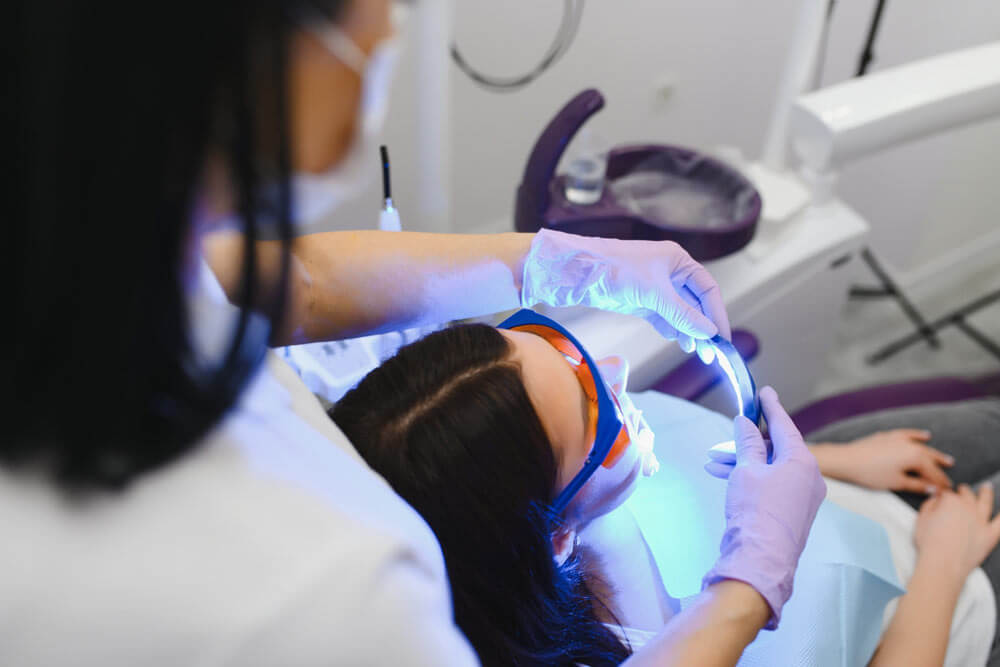
Laser dentistry works by directing concentrated energy onto a specific area of the tooth. Er:YAG and Er,Cr:YSGG lasers are particularly relevant to hard-tissue procedures because their energy is strongly absorbed by water and components of tooth structure. This allows the laser to interact with decayed or targeted tissue in a controlled way. The goal is to treat the affected area while preserving as much healthy tooth structure as possible.
How Laser Treatment Can Reduce the Need for Anesthesia
One of the most appealing aspects of laser dentistry is the potential for treatment with little or no injectable anesthetic in selected situations. Traditional cavity preparation relies on a rotating bur to mechanically remove decayed tooth structure. Depending on the depth and location of the cavity, this process can create sensations that make local anesthesia necessary. Laser energy uses a different mechanism, and clinical research suggests that patients may experience less pain during laser-assisted caries removal.
A 2025 meta-analysis found that laser-assisted caries excavation was associated with less pain and a lower need for anesthesia than conventional bur treatment. However, the researchers also noted that laser procedures generally take longer, and the quality of evidence for some outcomes remains limited. This means “anesthetic-free” should not be interpreted as a guarantee that anesthesia will never be necessary. Deeper cavities, sensitive teeth, extensive treatment, or individual differences in pain response may still make conventional anesthesia appropriate.
What to Expect During Laser Dentistry
A Different Sensation Than Traditional Drilling
Laser treatment can feel different from treatment with a conventional dental drill. Depending on the procedure and the laser being used, patients may notice tapping, vibration, warmth, or a series of small pulses. Water spray is commonly incorporated into hard-tissue laser procedures to help manage heat and improve the interaction between the laser and tooth structure.
Laser dentistry is also not necessarily faster than traditional treatment. Recent research indicates that laser-assisted cavity preparation can require additional time compared with conventional drilling. The potential benefit is greater comfort and reduced reliance on injectable anesthesia rather than simply shortening the appointment.
When Anesthetic-Free Laser Dentistry May Be Considered
Laser technology can be useful in several areas of dentistry, although its suitability depends on the individual tooth, condition, and treatment plan. For example, laser-assisted caries removal may be considered when treating certain cavities, particularly when preserving healthy tooth structure and improving patient comfort are priorities.
Important factors include:
- The depth and location of the cavity
- The amount of healthy tooth structure remaining
- The type and wavelength of laser being used
- The patient’s sensitivity and comfort level
- The complexity of the required restoration
Laser dentistry is not automatically the best choice for every dental procedure. Some treatments still require conventional instruments, injectable anesthesia, or a combination of techniques. A careful dental evaluation is therefore important before determining whether an anesthetic-free approach is appropriate.
Understanding the Benefits and Limitations
The evidence surrounding laser dentistry continues to develop. Systematic reviews have found that laser treatment can provide comparable caries-removal results while potentially reducing discomfort and the need for anesthesia. At the same time, studies have identified limitations, including longer treatment times and variations in the quality of available evidence.
For patients who are nervous about needles or dislike the lingering numbness associated with dental anesthesia, these potential advantages can make laser dentistry an interesting option to discuss. Understanding both the benefits and limitations can help patients make informed decisions rather than assuming that every dental procedure can be completed without anesthesia.
For patients in Council Bluffs, IA, learning about newer approaches such as laser dentistry can make conversations about comfortable dental care more productive. BlueJay Family Dental and Steven Fidone recognize the importance of understanding modern dental techniques and how they may fit into individual treatment needs. As research continues to develop, laser dentistry remains an important technology in the broader movement toward comfortable, conservative dental care.
Resources
- Esteves-Oliveira, M., Schaffrath, K., & Wierichs, R. J. (2025). Efficacy of laser-assisted caries removal and hard tissue preparation: A meta-analysis. Journal of Dentistry, 156, 105697.
- Tao, S., Li, L., Yuan, H., et al. (2017). Erbium Laser Technology vs Traditional Drilling for Caries Removal: A Systematic Review with Meta-Analysis. Journal of Evidence-Based Dental Practice, 17(4), 324–334.
- Montedori, A., Abraha, I., Orso, M., et al. (2016). Lasers for caries removal in deciduous and permanent teeth. Cochrane Database of Systematic Reviews.